White Water Mold in a Cold Plunge: Why It Keeps Coming Back
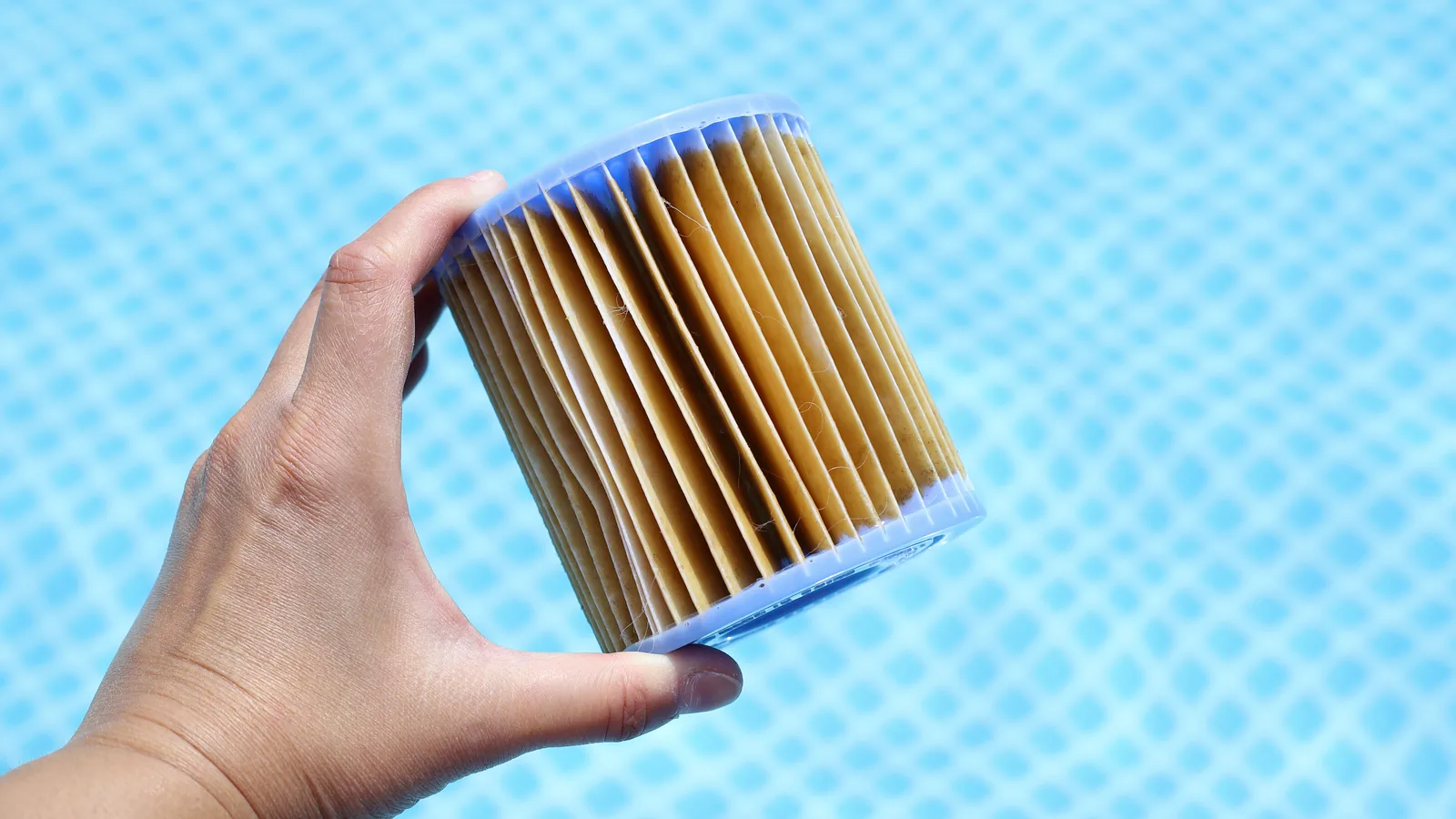
Our plunge grew white stringy stuff for most of a year. Tissue-paper flakes floating near the jets. A slick clear film at the waterline you could feel before you could see it. We drained it, scrubbed it with vinegar, scrubbed it again with bleach, refilled it, dosed it exactly the way the chemical company said, and eleven days later it was back.
Every search returned the same three paragraphs of pool-blog advice written for a chlorinated backyard pool, which is a thing we were not allowed to have. Our chiller manual bans chlorine and bromine outright. So the honest answer, the one nobody was writing down, took a long time to assemble. Here it is in one page.
The short version: the white stuff is almost never mold, and it does not live in the tub you keep scrubbing. It lives inside your pump, your plumbing lines and your heat exchanger, sealed under a slime layer that surface cleaners cannot get through.
The fix is not a stronger chemical. It is a surfactant purge run through the plumbing at the warmest temperature your setup allows, followed by a full drain, a shop vac, and a brand new filter.
The reason it came back is that cold water slows your oxidizer down far more than it slows the organism down. That gap is the entire disease.
What It Actually Is
Nearly everyone calls it white water mold. Taxonomically that is wrong, and the wrongness matters, because it explains why mold advice does not work on it.
The usual culprit is a water mold in the Saprolegnia group. These are oomycetes, members of the kingdom Chromista, and despite growing in fuzzy filaments they are not fungi at all. They are more closely related to algae. Fish keepers and aquaculture operations know them well as the cottony growth on sick fish. They reproduce by releasing motile zoospores that swim through the water, sail straight through a standard cartridge filter, and settle wherever there is something sticky and organic to hold onto.
In a cold plunge that means the dark inside of your PVC lines, the pump impeller housing, the pleats of the filter, and the narrow channels of the chiller's heat exchanger. Once anchored they grow a matrix of extracellular polymeric substance, which is a scientific way of saying self-made slime. That slime does three jobs at once: it glues the colony to the pipe wall so circulation cannot wash it off, it traps floating skin cells and body oil as a food supply, and it acts as a chemical shield.
The shield is the part that ruins you. When you dose the water, the sanitizer reacts with the outermost sacrificial layer of slime and gets consumed there. The colony underneath never sees it. Your chemical reading looks fine. The tub looks clean for a week. Then the concentration in the water drops back to normal and the colony regrows what it lost.
Those white flakes drifting past your knees are just fragments that got torn loose by water flow. You are not looking at the organism. You are looking at its shed skin.
If it has a pink tinge too
Pink slime often shows up alongside it. That is not algae either. It is Methylobacterium, a bacterium that takes shelter inside the water mold's slime layer and reinforces it. The two together are considerably harder to kill than either alone. Same treatment, but it tells you the colony is mature.
First: Prove It Is Actually Organic
Before you spend money on a purge, rule out the impostor. Calcium scale flakes off in white pieces that look almost exactly like detached biofilm, and if you have hard water, which most of the Southwest does, that is a live possibility. Scale needs a descaler and a pH correction, not a purge. Running the wrong protocol wastes a tank of water and a weekend.
The test takes 30 minutes and one glass.
| Step | What to do | What it means |
|---|---|---|
| 1. Sample | Scoop about a cup of tub water into a clear glass, making sure you capture several intact flakes. | Biofilm fragments usually look slightly translucent with a mucus halo. Scale looks opaque and hard-edged. |
| 2. Dose | Add roughly 20 drops of ordinary household bleach to the glass and swirl gently. | This happens on your counter, not in your tub. No chlorine goes anywhere near the chiller. |
| 3. Wait 30 minutes | Leave it alone and look again. | Flakes dissolve into cloudiness: organic. You have biofilm. Flakes stay solid and sink: inorganic. You have calcium scale. |
If it dissolves, keep reading. If it does not, you need a spa descaler and to get your pH under 7.8, and none of the rest of this page applies to you.
Why Cold Water Is the Real Problem
This is the part that took longest to work out, and it is the part that explains why a hot tub owner and a cold plunge owner using identical chemicals get completely different results.
Chemical reactions slow down as things get colder. The rule of thumb in chemistry is that a reaction rate roughly halves for every 10°C drop in temperature. Your oxidizer, whether that is a hydrogen peroxide product or a non-chlorine shock, depends on reacting with organic waste to destroy it. At 104°F in a hot tub it does that fast. At 50°F in a plunge it is working at a small fraction of that speed.
Meanwhile the organism does not slow down nearly as much. Saprolegnia stays active roughly from 37°F all the way to about 91°F. Aquaculture research puts its fastest mycelial growth between about 59°F and 77°F, which is warmer than your tub, but it is very much alive down at plunge temperature. That is exactly why it is a known cold water problem in fish farms.
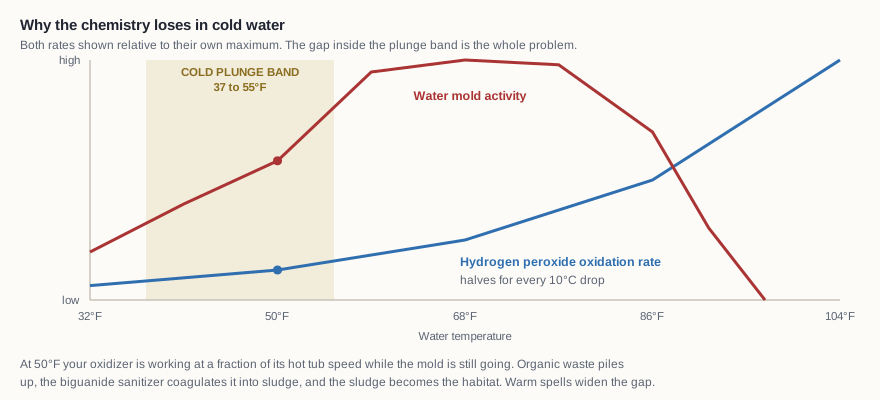
So organic waste accumulates faster than it gets burned off. And that unburned waste is food and scaffolding. This is the mechanism, and once you see it, the warm-weather pattern makes sense: our outbreaks always accelerated in summer, because the ambient warmth pushed the organism toward its fast-growth window while the tub water was still too cold to help the chemistry much.
The biguanide trap
If you run a chlorine-free biguanide system, and a lot of chiller owners do because it is the obvious answer to a no-halogen manual, there is a second problem stacked on top.
Biguanide sanitizers such as PHMB are polymers. They kill cells by disrupting cell membranes, but they are also strong coagulants. That is by design: they clump dead organic matter together so your filter can catch it. In a hot tub, with fast oxidation clearing waste and hot water keeping everything fluid, that works.
In cold water, where oxidation is crawling, the coagulant keeps clumping unoxidized waste into a soft gummy residue that coats your filter pleats, your skimmer throat and your pipe walls. That residue is close to a purpose-built habitat for a water mold: sticky, organic, protected, and permanently in the dark. Biguanide systems have a long reputation in the spa world for white water mold and pink slime outbreaks, and this is why. The sanitizer is quietly building the thing you are trying to kill.
One thing worth checking before you blame the chemistry entirely: these systems are sold as three-step programs, and the first step, a waterline control product carrying surfactants, is the one people skip because it sounds cosmetic. It is not. Those surfactants are what keep the coagulant from sticking to the shell and plumbing in the first place. If you are running steps two and three without step one, you have removed the only part of the system that was preventing buildup.
The Purge: What Actually Works
You cannot out-chemical a biofilm through the bulk water. You have to physically detach it from the pipe walls, and that takes surfactants, heat if you can get any, and flow. Set aside an afternoon.
Before you start: read your chiller manual and confirm what your heat exchanger is made of. This matters more than any other line on this page. Titanium and cupronickel units are commonly rated for halogens. Brazed plate exchangers bonded with copper generally are not, because chlorine attacks the copper brazing and a breach there means refrigerant enters your water loop and the unit is finished. If your manual bans chlorine, believe it, and never dose chlorine into a biguanide system regardless, since the two react into a sticky mess that ruins your filter.
Phase 1: Strip the plumbing
| Step | Do this | Why |
|---|---|---|
| 1. Pull the filter | Remove the cartridge entirely and set it aside for the trash. Run the purge with an empty housing. | Leave it in and it immediately traps everything you dislodge, killing flow before the cleaner ever reaches the heat exchanger. |
| 2. Get it as warm as you can | If your unit heats, take the water to 95 to 100°F. If it only chills, switch it off and let the water come to room temperature. | Surfactants work far better warm, and cold makes the gummy residue thicker and harder to lift. This is the single biggest difference between a purge that works and one that does not. |
| 3. Dose the purge cleaner | A jetted-tub plumbing cleaner such as Ahh-Some or Oh Yuk. Ahh-Some's own instructions are 2 oz per 100 gallons. Follow the label for whichever you buy. | These use cationic surfactants to cut surface tension and lift the slime off the pipe wall. Overdosing just produces foam you have to clean up. |
| 4. Circulate 30 to 60 minutes | Run the pump with every valve open. Ahh-Some allows up to four 30-minute cycles on one dose if the first is ugly. | Chemistry weakens the slime, water velocity tears it off. You need both. |
| 5. Skim the foam | Dark, greasy, unpleasant foam will build on the surface. Keep taking it off. Wear gloves. | That foam is your biofilm leaving the building. Seeing a lot of it is good news, not bad. |
Phase 2: Shock what is now loose in the water
The purge does not sterilize. It evicts. Now you have a tank full of freed zoospores and slime fragments, so hit them while they are exposed, using hydrogen peroxide rather than chlorine so nothing goes near your brazing.
Cold plunge sources commonly target 50 to 100 ppm of hydrogen peroxide for sanitation. Running the math on a 100 gallon tub:
- 35% food grade: about 54 mL for 50 ppm, roughly 110 mL for 100 ppm. That is a quarter cup and a half cup, near enough.
- 3% drugstore: about 21 fluid ounces for 50 ppm. Workable but you are pouring most of a bottle, and it carries stabilizers you did not ask for.
- Scale it yourself: multiply gallons by 0.54 mL to get the 35% dose for 50 ppm.
A caution worth stating plainly, since a lot of blog posts skip it: 35% food grade peroxide causes serious chemical burns on skin contact. Gloves and eye protection, and add it to water rather than the other way around. If that makes you uneasy, use 3% and pour more.
Note that one widely repeated figure online, 32 fl oz of 3% peroxide for 50 ppm in 100 gallons, is simply wrong. That dose lands around 75 ppm. It is inside the safe band so nobody notices, which is presumably why it keeps getting copied.
Phase 3: Get everything out
- Drain completely, then vacuum. Gravity is not enough. Use a wet/dry vac on the bottom drain, the skimmer housing and the filter canister. Any puddle you leave behind reinoculates the fresh fill on day one.
- Wipe the shell. It will be coated in residue from the foam. Diluted purge cleaner or 3% peroxide, then rinse thoroughly.
- Throw the old filter away. Not soak it, not bleach it. Zoospores survive inside pleated media and a cleaned filter is how people redo this whole job a month later. A new cartridge is the cheapest part of the operation.
- Clean the chiller's inlet screen. Most units have a mesh strainer catching hair and debris before the heat exchanger. Pull it, scrub it under hot water, soak it in peroxide.
What to Run Afterward
If you go back to exactly what you were doing, you will be back here in a month. The chemistry has to change, and the direction to move is away from anything that coagulates and toward something that oxidizes cleanly.
Hydrogen peroxide as the primary sanitizer is the straightforward option for a no-halogen tub. It leaves no residue, since it decomposes into water and oxygen, so there is nothing for a colony to anchor to. It is fine for copper brazing. It is also the option that requires you to actually test, because peroxide gets consumed by organic load and drifts down without warning you. Peroxide test strips are a few dollars and are the difference between a system and a hope.
If your chiller has an ozone injector or a UV-C tube, use it. Ozone destroys organic matter aggressively inside the plumbing loop where the colonies actually live, and UV-C sterilizes zoospores as they pass through, stopping them from establishing anywhere new. Neither leaves a residual in the tub, which is precisely why you pair them with peroxide rather than replacing it.
If your unit has neither and you are shopping, that is worth weighing. Our chiller guide covers what to look for, including heat exchanger material, which almost nobody lists in a spec sheet and which determines your entire chemical future.
Keeping It From Coming Back
| Habit | Standard | Why it matters |
|---|---|---|
| Rinse before you get in | Quick warm shower with soap, every session. | The single highest-leverage habit here. Sebum, sweat, skin cells and lotion are the food supply. Cut the food and the colony cannot scale. |
| Circulate | 4 hours daily minimum, continuous is better. | Zoospores attach in still water. Moving water keeps them from anchoring and distributes sanitizer evenly. |
| Filter care | Rinse weekly under pressure, replace every 30 to 60 days. | A loaded filter is a nursery, and it strangles flow to the chiller, which shows up as flow errors and poor cooling. |
| Water chemistry | pH 7.2 to 7.8, alkalinity 80 to 120 ppm. | Outside that band you degrade components and blunt the oxidizer you are relying on. |
| Purge on a schedule | Every 3 to 4 months, whether or not the water looks clear. | This is the one people drop once things look fine. Clear water means the colony is small, not absent. A quarterly purge strips it before it is visible. |
The Shopping List
Everything the purge needs, in one place. Nothing exotic.
- Jetted tub plumbing purge cleaner, Ahh-Some or Oh Yuk. One dose covers a plunge several times over.
- 35% food grade hydrogen peroxide, or 3% in bulk if you would rather not handle the strong stuff.
- Peroxide test strips reading to at least 100 ppm.
- A new filter cartridge (order the one your tub model specifies, cartridges are not interchangeable), sized to your unit. Buy two.
- A small wet/dry vac for clearing the drain, skimmer and filter housing.
- Chemical-resistant gloves and eye protection. Not optional with 35% peroxide.
What We Would Tell Ourselves a Year Ago
Stop treating the water. The water is the symptom. Everything you can see is downstream of a colony you cannot see, living in a pipe you cannot open, and no dose you add to the basin is reaching it.
The other thing: the recurrence is not your fault and it is not a discipline problem. A cold plunge running a coagulating sanitizer in cold water is a system whose chemistry has been slowed below the growth rate of the thing it is supposed to be killing. It was always going to come back. Change the system and it stops.
Get the printable one-page protocol
Temps, times, weekly dose, progression ladder and the safety rules on a single sheet. Print it and stick it next to the tub.
Download the protocol PDFCommon Questions
Is white water mold dangerous to plunge in?
It is not a recognized human pathogen the way Legionella is, and healthy people generally are not harmed by incidental contact. That said, a visible biofilm means your water is carrying a heavy microbial load in general, and open cuts plus dirty water is a bad pairing. Do not use the tub until it is dealt with.
Will draining and refilling fix it?
No, and this is the most common wasted weekend. Fresh water enters a plumbing system that still has the colony in it and gets reseeded on the first pump cycle. You have to purge, not just replace.
Why does it come back faster in summer?
Warmer ambient temperature moves the organism closer to its fast-growth range, while your water stays cold enough that your oxidizer is still sluggish. The gap widens in both directions at once.
Can I just use more sanitizer?
No. The slime layer consumes the outer dose and shields the colony underneath, so you burn chemical without reaching anything. That is the defining property of a biofilm and the reason surface treatment fails.
Vinegar did nothing. Why?
Acetic acid is a decent surface cleaner on non-porous household surfaces, but it lacks the surfactant action needed to penetrate the slime matrix, and you were applying it to a shell that was never the problem. Right chemical, wrong location, wrong job.